
The Five Pillars of Work: How to Transition from a Job to a Portfolio Career
The biggest challenge will be psychological.


The great unbundling of the job
I’ve been thinking out loud about work, technology, and reinvention for a while now. Writing my way through questions I certainly don’t have full answers to. Trying to make sense of my own transition while connecting it to the bigger shifts reshaping how we live and work. What began as personal reflection has turned into a wider inquiry: what happens when the system that shaped our lives starts to fall apart?
At its core, my writing has circled around how work is the organizing principle of modern life and how it’s being profoundly disrupted right now.
In one of my earlier essays, I wrote about how the traditional job comes as a bundle: salary, a daily routine, colleagues, status, healthcare, even a ready-made sense of belonging. That job bundle used to be a decent deal. But the deal’s been breaking down for years. Not because of one dramatic event, but a a perfect storm of technological, cultural, and economic shifts.
The old model of one job, one employer, one title is cracking. Automation and AI take over tasks that used to require teams. Global platforms make geography irrelevant. Wages flatline while costs keep climbing. Jobs for life turned into short-term contracts, gig work and project-based roles.
I’ve explored how one job rarely fulfills all the reasons we work. Gen Z especially, but not only, demands flexibility, work that fits their beliefs, and protection for their mental health, seeking meaning, community, and social purpose beyond the paycheck. So instead of squeezing themselves into one corporate identity for life, more people are starting to rebuild the bundle on their own terms. A self-designed mix of stability, purpose, and autonomy: the portfolio career.
In The End of Work for a Paycheck, I tried to imagine the next horizon: a post-labor world where income itself starts to decouple from employment. What happens when jobs no longer sit at the center of life? What fills that space instead?
Across all of it, one question keeps resurfacing for me: could the portfolio career be the transitional model between the collapsing world of jobs and a more self-authored, fulfilling way to live and work?
And how can we help more people to make the transition?
The biggest challenge will be psychological
Over the past year, I’ve spoken with dozens of people who are standing right at the edge of change. Some are still in their jobs but secretly restless, tinkering with side projects after hours. Others have already quit, are on a sabbatical and now sit in front of blank calendars, wondering what to do with all that freedom they thought they wanted. A few others are already experimenting with portfolio lives.
What struck me is how similar their stories sound. These are smart, capable people - often successful by any external metric - yet most of them run some of the same scripts picked up over the course of their lives and especially their careers. Leaving a traditional job isn’t just a professional pivot; it’s an identity collapse. The old scaffolding disappears overnight. Suddenly there’s no title to hide behind, no meeting schedule to make you feel productive, no clear answer to “so, what do you do?”.
When people leave their jobs to become self-employed, they tend to focus on the visible things: new projects, clients, income streams. What they don’t realize is that the real work happens underneath. The internal rewiring. The part where you have to unlearn the scripts that once defined success and learn to build your own structure, story, and sense of belonging from scratch. That’s the real transition and in a portfolio career it’s not done by HR but by you.
The Five Pillars of Work
To support this transition, we’ll need a new blueprint that helps people consciously rebuild the components of their working life that were previously bundled together in the traditional job. Through my conversations, research and own experiences, I categorised those into five invisible pillars: vision, money, identity, structure, and community. They hold your working life together until the moment you walk away and they collapse one by one.
When leaving a traditional job, you lose the roadmap (vision), the paycheck (money), the title (identity), the routine (structure), and the colleagues who made the days tolerable (community). What’s left is a pile of rubble and a lot of blank space: the raw material for something new.
Most people panic at that stage. I did too. The willingness to exist in this ‘undefined space’ is critical groundwork but damn, it’s not easy. What looks like collapse is really construction in disguise. Each one of these pillars can be rebuilt consciously.
I hope my framework is a way to understand a bit better what actually breaks when you leave the traditional job and how to rebuild it into a self-authored portfolio career.
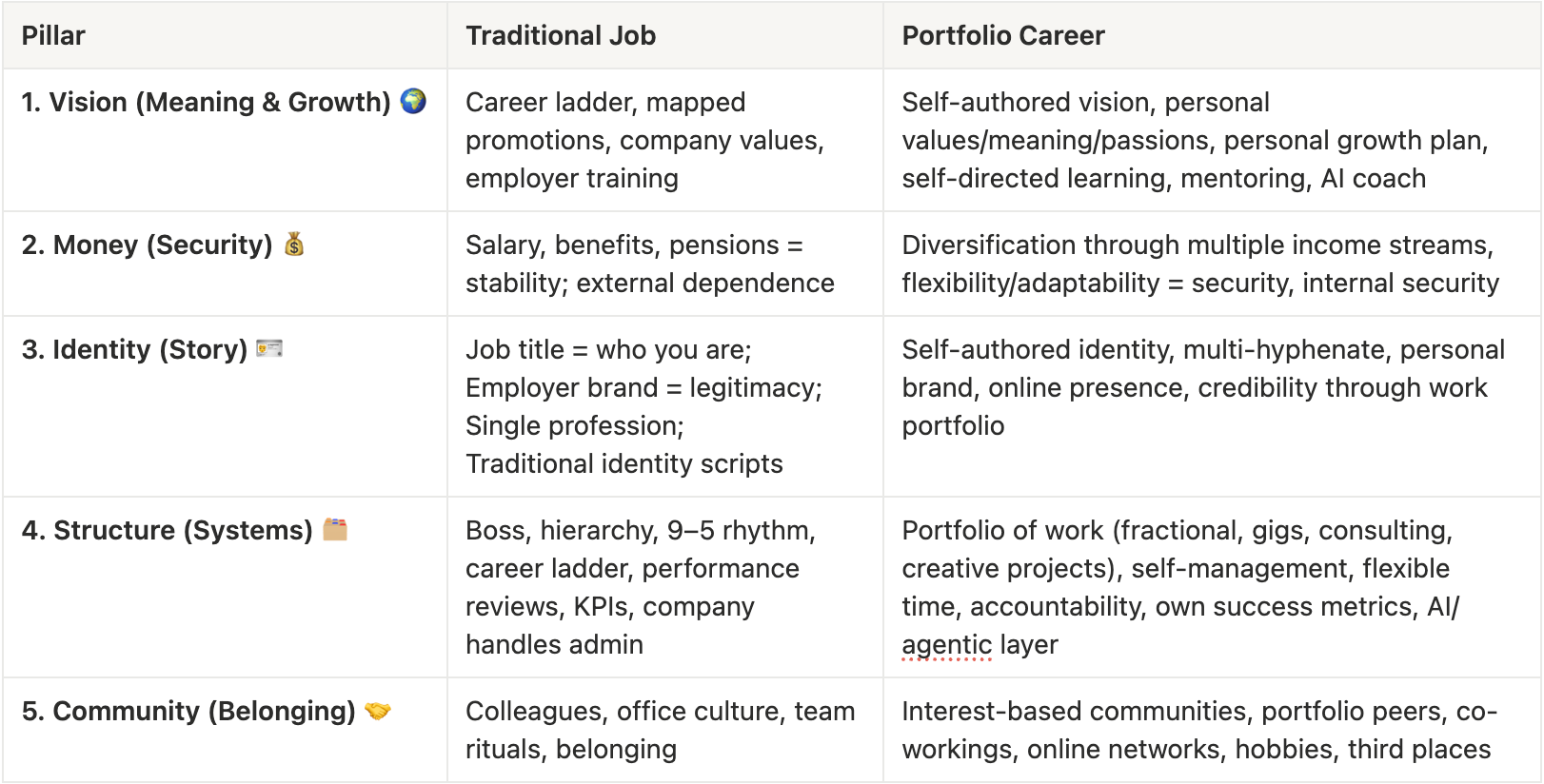
The five pillars and their manifestation in both the traditional job and the portfolio career are:
Vision (Growth & Meaning)
In the Traditional Job:
Your path is mapped out for you. Growth follows the career ladder defined by promotions, titles, and annual reviews. Development comes through employer-sponsored training, and meaning is often borrowed from the company’s mission and values. You learned to align your ambitions with the organization’s direction rather than your own.
In the Portfolio Career:
You design your own map. Growth is self-authored, guided by long-term purpose, curiosity, and personal values, which are acknowledged to evolve with life priorities. The focus shifts from a “one time linear career path” to an “ever-evolving portfolio career”. This requires setting up one’s own personal growth plan, where self-directed learning, reflection and reassessment are key for alignment. Mentors or your AI coach can help you on this journey, but in the end it’s up to you.
Transition struggles:
This is disorienting because it exposes how much of one’s vision was never truly one’s own (“I need to stop living on borrowed definitions of success”). People feel lost, still equate success with upward motion (promotion), and may overthink instead of experiment (“I can’t just start posting on LinkedIn”), feeling terrified by the expansive freedom. They have never learnt to listen to themselves, follow their curiosities, believe in their agency or live with uncertainty. Yet, they suddenly need to define success internally and commit to a self-directed, non-linear journey without anybody telling them how to do that. They may find themselves missing key skills or knowledge and face a new challenge: learning how to learn independently.
Money (Security)
In the Traditional Job:
Security comes in a single package: a fixed salary, benefits, and a pension plan promise stability and predictability. Your financial safety is outsourced to the company: as long as you stayed employed, your needs are covered. Money is steady but tied to loyalty and time spent, not necessarily to value created.
In the Portfolio Career:
Security is something you design, not receive. Income is intentionally diversified across multiple streams, such as fractional roles, consulting, creative projects, or digital products. Security is built through resilience and adaptability, ensuring that when one income stream shifts, others sustain you. The focus moves from external dependence on one employer to internal security.
Transitioning struggles:
Deep conditioning ties income from employment to security and self-worth, causing anxiety during the shift. This leads to fear-based decisions, such as overcommitting to short-term paid work at the expense of long-term goals (“I technically have like four jobs now and not enough time to focus on my own things”). Few people have a clear definition of “enough” and remain geared toward limitless growth and earning (“By accepting all three opportunities, I could double my previous salary”). Others have just started a family and the provider script runs deep (“With my kids, I just cannot afford two years of lower income”) reinforcing the underlying belief that ‘employment = security’. The necessary shift involves emotional regulation around money, learning to build security from diversification, flexibility and self-trust in one’s skills.
Identity (Story)
In the Traditional Job:
Your job title defines who you are. Legitimacy comes from the company you work for, the logo on your email signature, and the clarity of a single professional label. Success is externally validated - promotions, LinkedIn titles, business cards. You fit into a structure that gives you credibility and a sense of belonging, but also limits how you can express your full self.
In the Portfolio Career:
You define who you are. Identity becomes self-authored: a mix of your skills, experiences, values and interests woven into one coherent story. You’re a multi-hyphenate, not a job title. Credibility comes from your work itself which are the projects you create, the communities you build, and the people you impact. You don’t fit into a role; you design your own category of one.
Transitioning struggles:
This is often the hardest and most emotional shift because it challenges the beliefs we were raised with: that you are what you do, that titles equal legitimacy, you should focus on one thing, best for the rest of your life and resting is laziness. Once those structures fall away, many people feel their identity being taken away, uncertain how to describe what they do (“I do marketing stuff and a bit of yoga”), or worried about appearing unfocused or being judged by their social circles (“I was mocked for working at a festival just because I enjoy it”). They experience discomfort with claiming expertise without institutional backing or year long experience (“I can’t just start speaking about quantum physics without years of experience”). Many feel guilty when not producing, due to scripts inherited from the corporate world, where self-worth is inherently tied to constant, measurable productivity (“I have the feeling I’m basically useless when, say, from 12 to 3 I do nothing”) or constantly proving one’s worth (“I was very ego driven trying to prove that despite all the difficulty in my life, I could still make it”).
Systems (Structure)
In the Traditional Job:
Your days follow a clear rhythm: 9 to 5, meetings, deadlines, and performance reviews. A boss defines priorities, and the company handles logistics like payroll, taxes, and vacation days. The structure is built for you, offering predictability and guardrails, but leaving little room for flexibility or self-direction.
In the Portfolio Career:
You build your own systems. Structure becomes self-designed around your own portfolio components such as fractional work, consulting, advisory, digital services and products or creative work arranged around your vision. You need to manage your own time, define your own KPIs for success and hold yourself accountable. Depending on the country you live in, the support systems will be different around taxes, accounting, and welfare. An AI support team (or agentic layer) can take on some of the work and make up your team of one.
Transitioning struggles:
When you leave a traditional job, the loss of structure can take you by surprise. The calendar that once dictated your days disappears overnight, so days can feel unanchored. Some might struggle with organizing themselves and defining priorities. Designing a sustainable weekly rhythm takes time and it’s easy to swing from overplanning and overworking to drifting. Some struggle to stay accountable, others to allow real rest. Deciding which opportunities to pursue and how to build a wholesome, balanced portfolio of work requires both entrepreneurial thinking and emotional discernment. Suddenly, you’re managing multiple income streams, context-switching across projects, and learning to define your own KPIs for success beyond traditional corporate metrics to include new ones such as mental health, time with family or contribution. Few people realize how much AI can now support to make a portfolio career work by forming the foundation of a “team of one”. Ultimately, it’s about designing a personal operating system: clear rhythms, defined success metrics, and accountability structures that sustain your freedom rather than replace it.
Community (Belonging)
In the Traditional Job:
Your community and sense of belonging come built-in through colleagues, office culture, and team rituals. You share lunch breaks, inside jokes, and a company identity. Community forms around proximity and shared goals, but it’s often tied to the job itself. When you leave the company, you often leave the community, too. And also in your private circles, your job gives you credibility and belonging.
In the Portfolio Career:
You create your own circles of belonging. Community becomes intentional and interest-based built around shared values, curiosity, and purpose rather than shared employers. You find connection in co-workings, creative hubs, online spaces, or local projects. Instead of one fixed tribe, you cultivate a network of peers who inspire, challenge, and grow with you. Third places and online networks are starting to take over what the office once provided.
Transitioning struggles:
This is where many people wobble. Not going to an office or having colleagues around can feel surprisingly isolating. Some miss being part of a shared mission, a team moving toward the same goal. Meanwhile, they’ve changed but their old environment hasn’t. Friends or family still see them through the old lens. They feel judged for doing ‘less serious’ work, or for exploring things that don’t fit the traditional script. Some might experience significant social devaluation and judgment regarding their unconventional career choices (“I enjoy working a day at a café for fun but constantly receive stupid remarks for such endeavors”). They long for peers who get it, who also stepped off the conveyor belt and are building life differently. Stepping outside one’s bubble and finding a new community is the hidden catalyst.
So, what now?
There’s far too much to say, too much being felt, lived and experimented with to capture this whole transition in one piece. Probably I’ve generalized too much. My goal here was to make sense of what actually changes when you move from a traditional job into a portfolio career, and to name the challenges that surface along the way. Because once we can see the patterns, we can start to move through them.
I haven’t talked much today about the upsides: the joy, freedom, curiosity, and deep sense of aliveness this path can bring. If you’ve been following along, you already know I’m obsessed with the portfolio career and its potential to create a more fulfilling way of working and living. Maybe even a more human operating system for life.
I quit my job over 1.5 years ago and have been on the reinvention journey ever since. I’ve given up my five pillars of work with a bang, picking up the pieces slowly over the years to build my own portfolio career.
I’ve gone (and am still going) through the identity unravelling, my own vision creation process, the money fears, re-structuring my day, building my portfolio components and my community outside of work. Since I quit, I’ve had moments of doubt, yes. But I’ve also felt more excited about life than I have in years. I’ve become way more present. Way more optimistic. I see so many opportunities, so many different ways how life can be lived. I’ve rediscovered old interests. Learned things I never made space for before. I’ve been writing, connecting, experimenting. And I feel like I actually own my life.
So what’s next? Two things mainly, both going a bit from big picture-thinking to more practical guidance.
In the next newsletters, I want to dive into each pillar and describe my journey in more detail, how I’ve overcome some of the described challenges, what solutions have formed and show more of the excitement of this type of working.
Alongside this, I’ve developed a mentoring framework based on the five pillars of work to help people through the process of going from a traditional job to a portfolio career. Basically a way to better understand where you are in your transition, which scripts you’re still running, what areas you might be going strong already, so we can see the gaps and build a plan with you how to continue.
My hope is that this work makes the transition toward a self-authored portfolio career feel less overwhelming, more possible, and maybe even a little inevitable.
📚 Read the full Five Pillars of Work series:
The Five Pillars of Work: How To Transition From A Job To A Portfolio Career (this one!)
The Five Pillars of Work: Rebuilding Vision from the Inside Out
The Five Pillars of Work: The Power of Intentional Community Building
Upcoming: Three articles on the missing pillars Structure, Identity & Money
👥 Portfolio Career Mentoring:
Rooted in my Five Pillars of Work framework, I offer two mentoring pathways designed to help you transition into a portfolio career.
Your thoughts really struck a chord with me, thanks for sharing. I’m in the early days of my sabbatical and can definitely see the different pillars you mention.
What is interesting for me is the reaction of the “outside” world - it seems there is a big divide between those of us transitioning into portfolio careers and the people looking at things in a more traditional way. I think the societal pressure is something not to be underestimated in this change, especially in some cultures. Maybe an angle for your to consider, too?
It’s like you’ve been reading my journal entries for the past 6 months haha. Thanks for clearly unraveling such a robust topic, Iwana.
I feel infinitely more free in carving my my creative pursuit the way I want to. No matter how many shapes and sizes it adopts at a time over time, it feels real and embodies expressions of me.
In the 2+ years that I worked full-time after graduating, I amassed 8 internationally recognised awards in 5 months. I was hoping to leave the establishment with at least 2 or something. So, ooo la la I guess, but those awards no longer resonate with the magnitude of my creative offerings. They’re now an embellishment for my portfolio — a “proof of competence” if you will — and a gravestone for my desire to do brand design (or frankly, just creative production constantly under someone else’s sway) on-demand.
If I could manage that in a space and time that also couldn’t accommodate my neurodivergence as well as I needed … well, shoot, imagine what I could do with my own agency!
I’m in the early portfolio career building stage. So, there’s a lot of experiences, thoughts, sentiments, ideas, whatevers that have become SO MUCH clearer with time and intuitive practice. The financial aspect is temporarily biting me in the bums. However, I am without doubt that my financial freedom will grow prosperously alongside my creative freedom.